Georgia-born Herb White is making ghost stories real


.avif)
.avif)














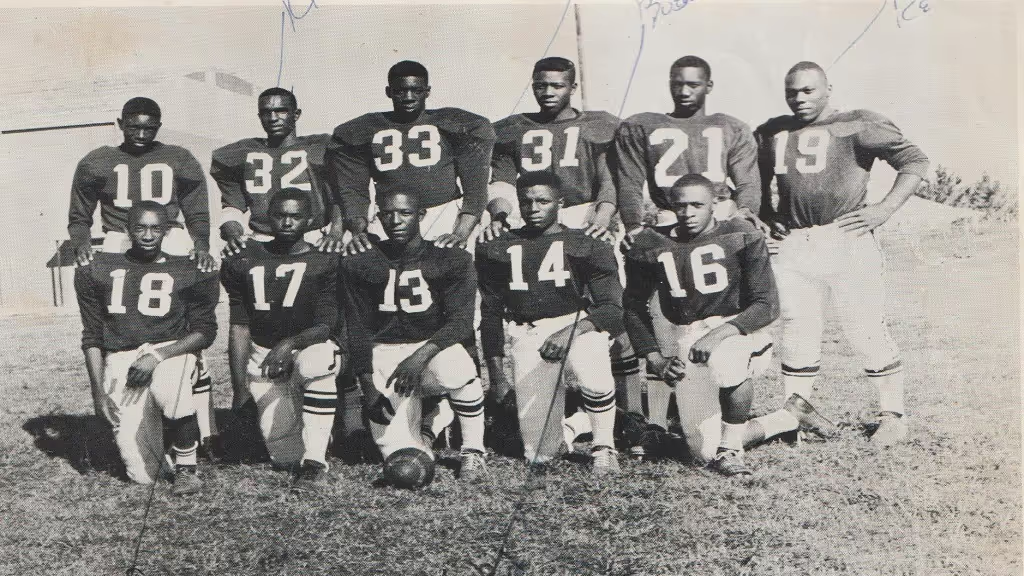
Herb White, nicknamed the Elevator from Decatur, is known by most in Georgia as an all-time great high school basketball player who went on to play with the Atlanta Hawks for a year in the NBA. But now the Elevator has turned into an executive producer, as his documentary, As If We Were Ghosts is set to air on all Georgia Public Broadcasting stations on June 13 and June 19--Juneteenth, the day that celebrates the emancipation of African Americans in the United States. The documentary takes a deep dive into the history of segregation in Georgia high school athletics from the 1940s to the 1960s, between the white Georgia High School Association (GHSA) and the black Georgia Interscholastic Association (GIA).
This project has been in the works for a while, with the idea for it being born in 2004. White had worked on the project for eight years while he was at Georgia Public Broadcasting, but after he retired from the station, the project remained untouched for nearly a decade. It wasnt until Ron Bivins, someone White had interviewed for the documentary back in 2005, called and asked about what happened with the film that meant so much to him.
About 15 months ago I got a call from him [] And he said were going to get this thing completed, White said.
So, thats exactly what they did. Bivins stepped up as another executive producer for the film and hired Monty Ross, who has co-produced several Spike Lee productions, to be in charge of creatingthe documentary.
To say White is excited about the project being completed is an understatement.
Im just tickled to death that its finally coming to light. I made a lot of promises to some people. When I talked to folks and interviewed them, Id say, were going to finally tell your story and youre going to get the recognition you deserve, White said.
Now after 18 years, peoples experiences will be known at last. Many of the student-athletes who competed in the GIA had their skills and achievements go unnoticed. White recalls becoming friends with many black basketball players who went to Trinity High School, which was the all-black high school in Decatur. He played with them at the segregated black gyms and they played with him at the white gyms. The Trinity team won a state championship in 1966, but the only piece written about it at the time was a short blurb in the local newspaper. While White was receiving all the praise for being a great player, he knew there were others who merited acclaim.
When I was a senior in high school, I got recognized by the [Atlanta Journal Constitution] as the No. 1 basketball player in the state of Georgia. After playing at all those black gyms, I knew there were a lot of other guys with equal talent to mine who never got the recognition, White said. I wanted to recognize those guys from Trinity who were my friends.
Not only did black student-athletes not receive equal recognition for their accomplishments, but they were also forced to deal with a great deal of discrimination as well. Atlanta-native and NBA Hall of Famer Walt Frazier told White that when traveling to a state championship game, he couldnt eat at most restaurants and couldnt stay at any hotels. He and his team had to resort to sleeping at the houses of the players on the other team.
Can you believe that? So youre going to play against a guy tomorrow and hes staying at your house that night? I mean, thats just crazy, White said.
Student-athletes also of course had to deal with police harassment. Coaches said it was impossible to get good equipment and had to wear hand-me-down uniforms. Many GIA teams didnt even have their own stadiums or facilities to play and practice in. As for the mindsets of the white student-athletes and coaches toward the GIA? It was as if they were ghosts.
The [white] coaches and players had never heard anything about the black players. Nobody knew about the GIA, White said. It was just ignored. They just didnt exist.
White credits his advocacy for social equality to his mother, who was from Indiana and had family from New York. He said she raised him to view people as people and not as black or white. He has maintained this attitude his entire life and it carried over into his interactions with his friends who went to Trinity.
When I got to know those guys in Decatur, it really expanded my horizons. People are people, no matter who they are, White said. I used to go to their house and eat with them and I would go to concerts with them.
White acknowledged that the United States has made progress since the GIAs existence, which also coincided with the civil rights era. However, he pointed to all the murders of unarmed black people over the last several years as an indicator that there is still a long way to go. He also said that its important for schools to teach the racial history of the United States.
Just to ignore it and say it didnt happen is a disaster. No matter how bad it was, our young people need to know about it, and thats why Im hoping that some young people will be able to see this documentary, White said.
Understanding this countrys past is what White wants viewers to take away from the film.
A lot of the past has been covered up. Theres all this political discussion about teaching the racial history of the United States in our schools, and you know, its an important issue, White said. I hope that it will shine a light on what was covered up as far as sports, but also more importantly, what was covered up in society and hopefully its something we can learn from.
As If We Were Ghosts airs on all Georgia Public Broadcasting stations at 7 p.m. on June 13 and 5 p.m. on June 19.